Fasting During Chemotherapy: What the Evidence Actually Shows
Fasting during chemotherapy has moved from the fringe to serious study at major cancer centers, and patients increasingly ask whether skipping meals around treatment could help. The honest answer is layered: the laboratory science is compelling, the human evidence is early, and for some patients fasting is genuinely unsafe. This review walks through what the research supports, who should avoid it, and, if your oncology team agrees, how it has actually been studied.
Key Takeaways
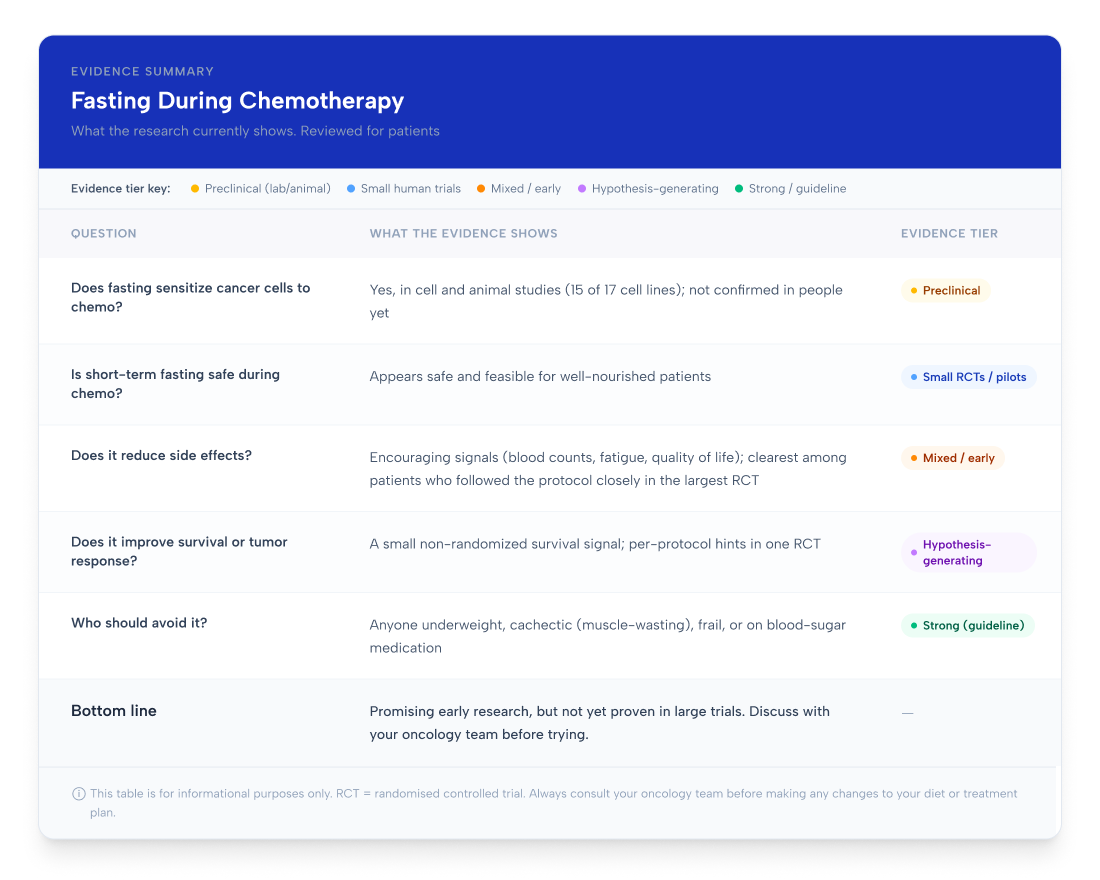
◉ In laboratory and animal studies, short-term fasting protected healthy cells while making cancer cells more vulnerable to chemotherapy, a concept researchers call differential stress sensitization. This has not been confirmed as a treatment effect in people.
◉ Across human studies, short-term fasting and fasting-mimicking diets appear safe and feasible for cancer patients who are well-nourished to begin with.
◉ Human signals: less of a drop in blood counts, better quality of life, reduced immune-cell DNA damage are encouraging; in the largest randomized trial, these benefits were clearest among the patients who completed the full diet, while the trial overall did not meet its primary endpoints, largely because many patients could not maintain the diet.
◉ Fasting is not appropriate for patients who are underweight or experiencing cachexia; major clinical-nutrition guidance warns that over-restriction can lead to malnutrition.
◉ What you eat in your feeding windows, especially adequate protein, matters as much as the fasting itself and is the key safeguard against losing muscle.
◉ Fasting during chemotherapy should only be considered with your oncology team, never as a solo experiment.
Why fasting during chemo is even a question
Intermittent fasting is a pattern of when you eat, not what. A fasting-mimicking diet is a stricter research version: a low-calorie, plant-based plan run for a few days under supervision. Both lower blood glucose, insulin, and IGF-1 (insulin-like growth factor 1, a hormone that signals cells to grow and divide). Healthy cells respond to that drop by downshifting into a protected, repair-focused state.
The laboratory science: differential stress sensitization
The interesting hypothesis is that cancer cells, locked into constant growth, cannot make that protective downshift, so scarcity widens the gap between normal and cancer cells. In the foundational laboratory work, short-term fasting sensitized 15 of 17 cancer cell lines to chemotherapy, and in mouse models fasting plus chemotherapy outperformed either alone. This is preclinical evidence, important for generating the idea, but not proof of a human effect.
What the human studies show
The most consistent human finding is feasibility and safety in well-nourished patients. A 2022 clinical study reported that a fasting-mimicking diet was safe and measurably reshaped patients’ metabolism and antitumor immunity. On symptoms, a randomized pilot found short-term fasting was well tolerated and reduced chemotherapy-related drops in blood counts, with faster recovery of immune-cell DNA damage; a separate cross-over pilot found fasting appeared to improve quality of life and fatigue. These are early studies, and they point toward benefit that larger trials still need to confirm.
The largest trial and what adherence revealed
The phase 2 DIRECT trial randomized 131 breast cancer patients to a fasting-mimicking diet or regular diet during neoadjuvant chemotherapy. Overall, it is recorded as not meeting its primary endpoints; there was no whole-group toxicity benefit and no improvement in pathological complete response, in large part because many patients found the diet difficult to maintain. Among the patients who adhered to the full set of fasting cycles, however, per-protocol analyses showed more frequent radiological responses and greater tumor-cell loss, plus reduced DNA damage to immune cells, and the fasting arm could omit the steroid dexamethasone. Per-protocol findings are a weaker form of evidence than a met primary endpoint, because patients who complete a demanding diet may differ from those who don’t, but the signal among those who followed through is notable. A separate 2024 subanalysis linked adding a fasting-mimicking diet to nearly double the median survival in advanced triple-negative breast cancer; it was small and non-randomized, but the size of the effect makes it worth further study.
Who should avoid fasting during treatment
This is the most important section. Fasting is the wrong choice for anyone who is underweight or experiencing cachexia, the muscle-and-weight wasting cancer can cause, because deliberate under-eating can accelerate dangerous muscle loss, which is associated with worse outcomes. Major European clinical-nutrition guidance cautions specifically against over-restriction during treatment because of the malnutrition risk. Patients on blood-sugar medication should also clear any change in eating timing with their team, because fasting can drop glucose too low; fasting trials have typically excluded patients with diabetes for this reason.
If your team clears you: how it’s been studied, and your eating windows
In studies, fasting was not open-ended. Short-fasting research used windows of roughly one to two days around the infusion; fasting-mimicking studies used a defined, supervised five-day low-calorie plan. These are descriptions of supervised research protocols, not a do-it-yourself prescription — the right approach, if any, is the one your oncology team designs. Equally important is what you eat when you do eat: feeding windows are the opportunity to protect muscle and maintain nutrition with adequate protein and nutrient-dense food, which directly counters the main risk of fasting.
Data at a glance
References
Lee C, Raffaghello L, Brandhorst S, et al. Fasting cycles retard growth of tumors and sensitize a range of cancer cell types to chemotherapy. Sci Transl Med. 2012;4(124):124ra27. pubmed.ncbi.nlm.nih.gov/22323820/
Vernieri C, Fucà G, Ligorio F, et al. Fasting-mimicking diet is safe and reshapes metabolism and antitumor immunity in patients with cancer. Cancer Discov. 2022;12(1):90–107. pubmed.ncbi.nlm.nih.gov/34789537/
de Groot S, Vreeswijk MPG, Welters MJP, et al. The effects of short-term fasting on tolerance to (neo)adjuvant chemotherapy in HER2-negative breast cancer patients: a randomized pilot study. BMC Cancer. 2015;15:652. pubmed.ncbi.nlm.nih.gov/26438237/
Bauersfeld SP, Kessler CS, Wischnewsky M, et al. The effects of short-term fasting on quality of life and tolerance to chemotherapy in patients with breast and ovarian cancer: a randomized cross-over pilot study. BMC Cancer. 2018;18(1):476. pubmed.ncbi.nlm.nih.gov/29699509/
de Groot S, Lugtenberg RT, Cohen D, et al. Fasting mimicking diet as an adjunct to neoadjuvant chemotherapy for breast cancer in the multicentre randomized phase 2 DIRECT trial. Nat Commun. 2020;11:3083. pubmed.ncbi.nlm.nih.gov/32848145/
Ligorio F, Lobefaro R, Fucà G, et al. Adding fasting-mimicking diet to first-line carboplatin-based chemotherapy is associated with better overall survival in advanced triple-negative breast cancer patients: a subanalysis of the NCT03340935 trial. Int J Cancer. 2024;154(1):114–123. pubmed.ncbi.nlm.nih.gov/37615485/
Muscaritoli M, Arends J, Bachmann P, et al. ESPEN practical guideline: Clinical Nutrition in cancer. Clin Nutr. 2021;40(5):2898–2913. www.clinicalnutritionjournal.com/article/S0261-5614(21)00079-0/fulltext
Anemoulis M, Vlastos A, Kachtsidis V, Karras SN. Intermittent fasting in breast cancer: a systematic review and critical update. Nutrients. 2023;15(3):532. pmc.ncbi.nlm.nih.gov/articles/PMC9920353/