What Actually Blocks Glutamine in Cancer Cells: The Complete Evidence Review
The video that accompanies this article gives you the complete list of drugs and compounds with published evidence against cancer glutamine metabolism, in four groups, numbered on screen. This article carries what the runtime could not: the study behind each item, the two questions about product quality that matter more than which compound you pick, and the reasons three widely recommended items are not on the list at all. If you have arrived here without watching the video, the short version is that glutamine dependence in cancer is settled biology, glutamine blockade as a therapy is not, and the distance between those two statements is where all the honest uncertainty lives.
Key takeaways
◉ Glutamine reprogramming in cancer is described as established across the 2024 and 2025 review literature, and two proteins, glutaminase and the ASCT2 transporter, are active drug targets with agents in human trials.
◉ Every open trial of a glutamine-targeting agent is restricted to people whose tumor carries a specific genetic marker, which makes tumor sequencing the practical first question rather than the drug name.
◉ Mebendazole is approved for parasitic worm infections and is not approved for any cancer. Its anticancer use is investigational and off-label. It is not fenbendazole, which is a veterinary drug.
◉ Green tea polyphenols and quercetin block the anticancer activity of bortezomib at concentrations reached through ordinary supplement doses. This is the single most actionable item in either the video or this article.
◉ Ivermectin does not belong on a glutamine list. Its antiparasitic target is a glutamate-gated chloride channel that does not exist in humans and has nothing to do with glutamine metabolism.
What glutamine does for a tumor
Glutamine is the most abundant amino acid in blood. Cancer cells import it through transporters, principally ASCT2, then convert it to glutamate using the enzyme glutaminase. Glutamate becomes alpha-ketoglutarate, which feeds the TCA cycle. Along the way the same pathway supplies nitrogen for nucleotides, carbon for lipids, and glutamate for glutathione, which is how a cell defends itself against oxidative stress.
That gives three places to interfere: the transporter, the enzyme, or the downstream steps. Almost every item in the four groups acts at one of those three points, and knowing which one is more useful than knowing the compound name, because it tells you what a cell can do to compensate.
Group one. Drugs in human trials
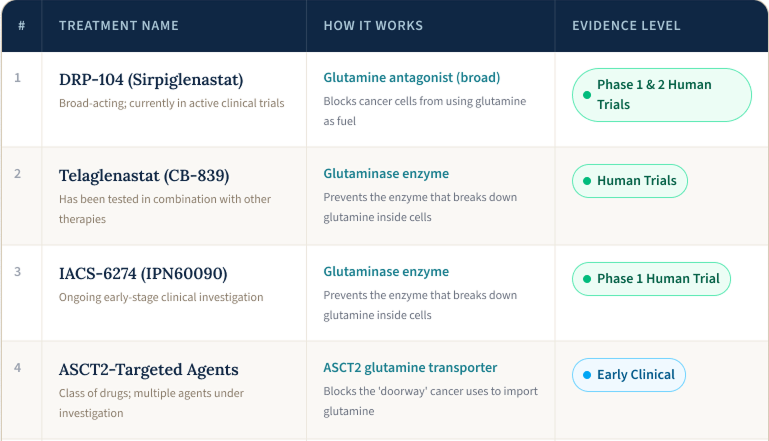
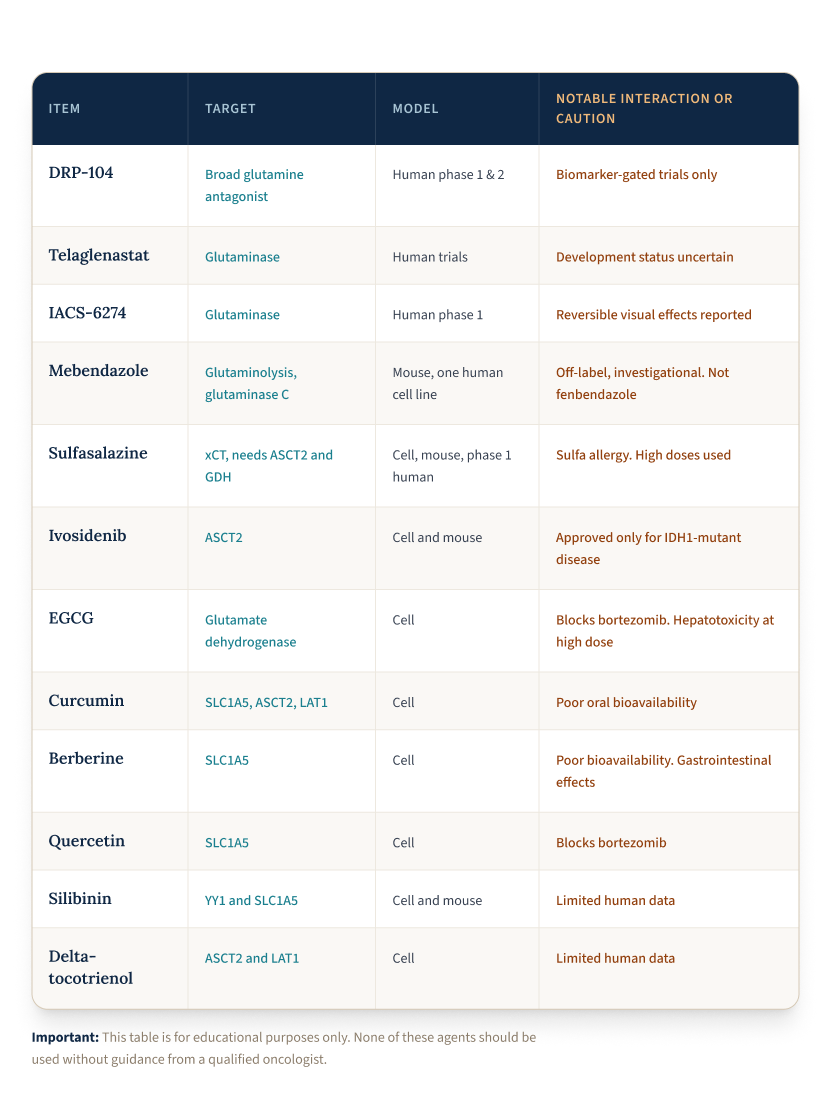
DRP-104, also called sirpiglenastat, is a prodrug of the broad glutamine antagonist DON, designed to become active inside tumor tissue rather than in the gut, where the original compound's toxicity limited it. It is in phase 1 and phase 2 studies. Telaglenastat and IACS-6274 are glutaminase inhibitors. Agents aimed at the ASCT2 transporter itself are in early clinical development.
How to read a trial listing before you contact anyone
The trials linked below share a feature worth understanding. They are biomarker-gated. One requires alterations in NFE2L2 or KEAP1. Another requires a DNAJB1 to PRKACA fusion. Others enrol on STK11, NF1, or low asparagine synthetase expression. This means the useful conversation with an oncology team does not start with a drug name. It starts with whether comprehensive genomic sequencing has been performed on the tumor tissue, and if so, what it found. Without that, eligibility cannot be assessed at all.
Group two. Approved for something unrelated to cancer

Mebendazole is approved by the FDA for pinworm and other helminth infections. It is not approved for any cancer indication, and any anticancer use is investigational and off-label. That distinction matters more than it may appear. Framing an off-label anticancer use as supportive care is clinically inaccurate, because supportive care means managing symptoms and treatment side effects, and mislabelling it that way makes an anticancer claim sound like a comfort measure.
In June 2026, Purna Mukherjee, Thomas Seyfried and colleagues published work in Cell Reports Medicine showing that mebendazole inhibited both glycolysis and glutaminolysis in an invasive mouse glioma model, and that glutaminase C expression was significantly lower in mebendazole-treated tumor tissue than in untreated controls. The greatest reductions in tumor invasion and progression, with prolonged survival, occurred when the drug was combined with a ketogenic diet rather than given alone. Mebendazole also reduced proliferation and viability in the human paediatric glioma cell line SF-188.
Two honest qualifications. This is a mouse study with one human cell line, not a human trial. And it comes from the laboratory that proposed the underlying hypothesis, which does not make it wrong but does mean independent replication has not happened yet.
Mebendazole is not Fenbendazole
These are different drugs and the confusion is constant. Fenbendazole is a veterinary antiparasitic. Its published anticancer mechanisms sit on the glucose side, including p53 activation, GLUT1 transporter inhibition and reduced glucose uptake, rather than on glutamine. If you read a claim about one and act on the other, you are acting on evidence that does not exist for the drug in your hand.
Group three. Indirect, or acting on the systems around glutamine
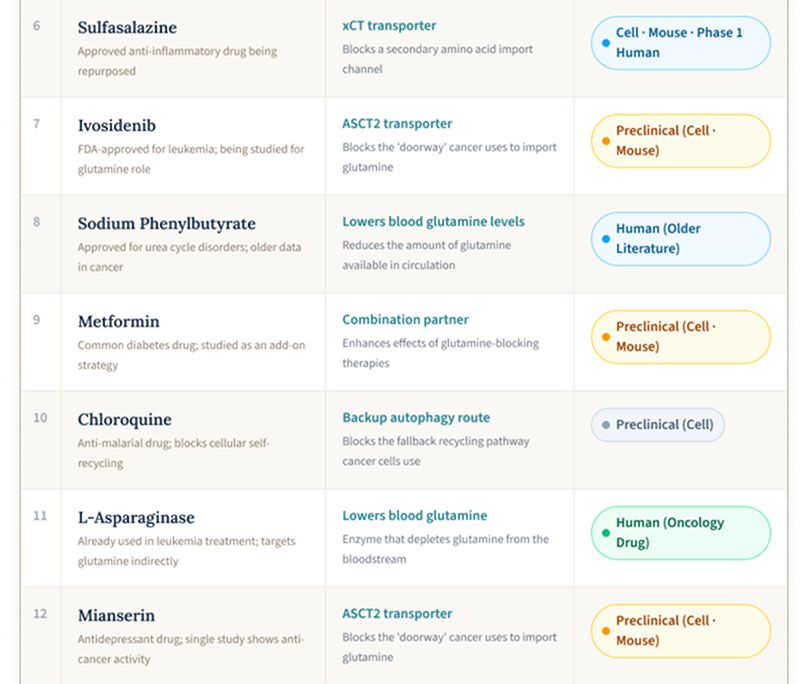
Several approved drugs interfere with glutamine handling without blocking it directly. Sulfasalazine, approved for ulcerative colitis and rheumatoid arthritis, inhibits the xCT cystine and glutamate exchanger. Its cytotoxicity in stem-like head and neck cancer cells depends on ASCT2-mediated glutamine uptake and glutamate dehydrogenase activity, which makes it the most mechanistically direct item in this group. It has also been through a phase 1 dose-escalation study in advanced gastric cancer, where reduction of CD44 variant positive cells and intratumoral glutathione was observed in some patients at 8 grams per day or more.
Ivosidenib, approved for IDH1-mutant cancers, has been shown to act as an ASCT2 inhibitor in colorectal cancer cells by a mechanism independent of its IDH1 activity. Sodium phenylbutyrate lowers plasma glutamine concentrations. Chloroquine blocks autophagy, which is one of the routes a cell uses to survive when glutamine is restricted. Metformin has no direct glutamine action and belongs here only as a combination partner: it prevents the compensatory increase in glutamine consumption that follows electron transport chain inhibition.
Group four. Laboratory observation only
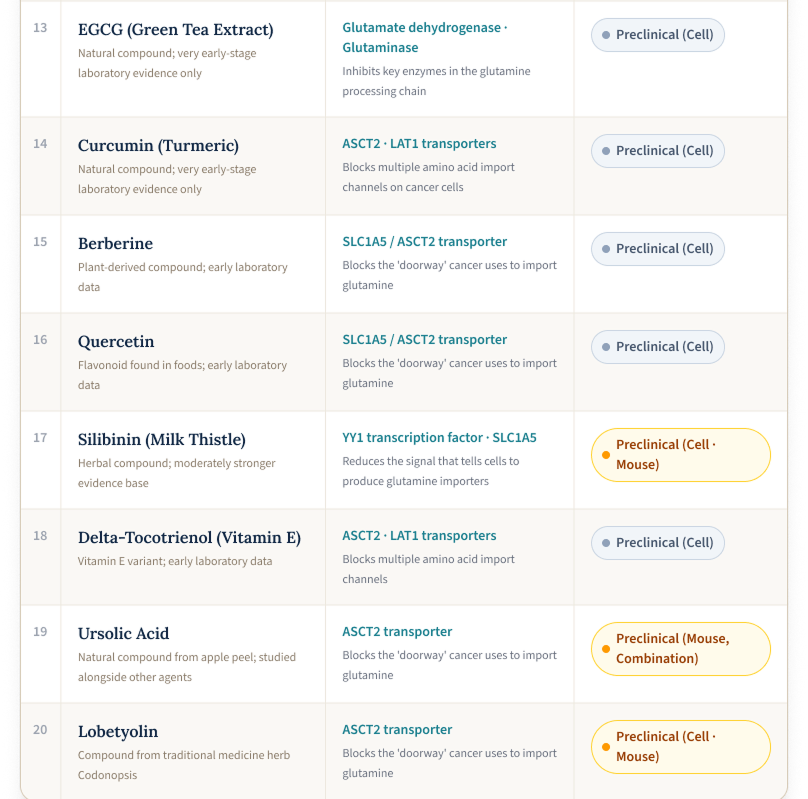
Six compounds have published evidence of acting on a named glutamine target in cell culture. EGCG from green tea inhibits glutamate dehydrogenase. Curcumin acts on SLC1A5, ASCT2 and LAT1. Berberine suppresses SLC1A5 and glutamine uptake in liver cancer cells. Quercetin inhibits SLC1A5 and has been shown to reverse chemotherapy resistance in colon cancer cells by that mechanism. Silibinin, from milk thistle, suppresses glioblastoma growth and glutamine metabolism through the YY1 and SLC1A5 pathway, in cells and in mouse xenografts. Delta-tocotrienol, a vitamin E fraction, inhibits both ASCT2 and LAT1 in non-small cell lung cancer cells.
The qualification that applies to all six is the same one that applies to almost all in vitro work. The concentrations used in cell culture are generally not achievable through diet, and in several cases not through supplementation either. Bioavailability is the specific limitation: EGCG has a plasma half-life of roughly three and a half hours, and curcumin's oral bioavailability is poor enough that most of the published cell-culture concentrations are unreachable by mouth.
What is not on this list, and why
Ivermectin is frequently named in discussions of glutamine and cancer. We could not find primary evidence that it inhibits glutamine uptake or glutaminolysis in cancer cells. Its documented anticancer mechanisms in the review literature are Wnt and beta-catenin signalling, PAK1, and mitochondrial membrane potential. The likely source of the association is a naming coincidence: ivermectin's antiparasitic mechanism is binding glutamate-gated chloride channels, which are invertebrate ion channels that do not exist in humans and have no relationship to glutamine metabolism. The two terms share four letters and nothing else. Ivermectin may well deserve its own discussion. It does not belong in this one.
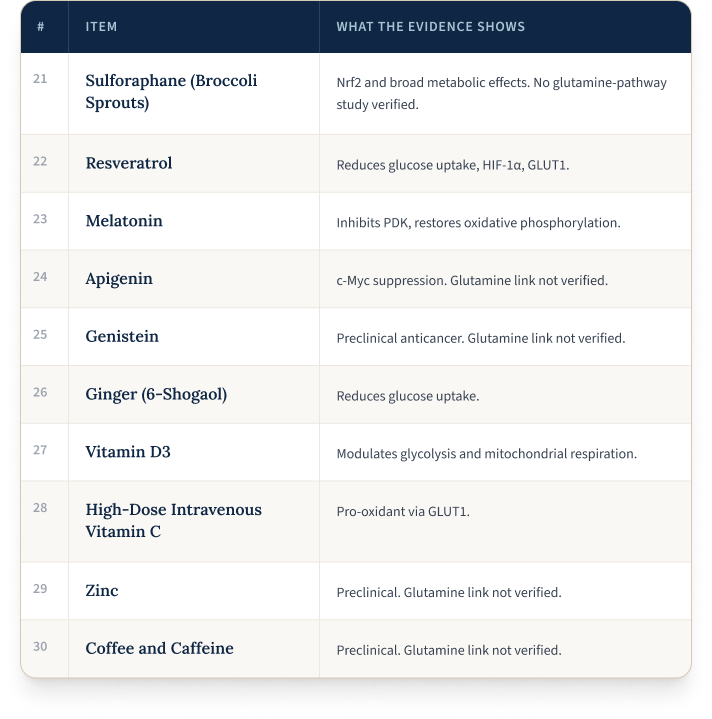
Resveratrol and melatonin are also commonly named. Their strongest metabolic evidence sits on the glucose side. Resveratrol reduces glucose uptake and downregulates HIF-1 alpha and GLUT1. Melatonin inhibits pyruvate dehydrogenase kinase and restores oxidative phosphorylation. Both are legitimate metabolic agents. Neither has a verified glutamine-pathway result, and presenting them as glutamine blockers would overstate what is known.
Sulforaphane, apigenin, genistein, zinc and coffee are studied in cancer metabolism but not shown to act directly on glutamine. That header is doing real work. We include them because viewers ask about them, and we label them accurately rather than promoting them into a list they have not earned.
The interaction that changes what you should do
If you are receiving bortezomib, sold as Velcade, do not take green tea extract or quercetin supplements without speaking to your oncology team first. Green tea polyphenols, particularly EGCG, bind directly to the boronic acid group in bortezomib and prevent it from working. In the original work this was not a partial reduction: tumor cell death induced by bortezomib was effectively abolished, both in cell lines and in mouse models. The effect was reported at concentrations as low as 2.5 micromolar, which is reachable with two to three 250 milligram green tea extract capsules. Quercetin has been shown to bind and inhibit bortezomib by the same chemistry, and the interaction applies to other boronic acid based proteasome inhibitors, not to non-boronic acid ones.
This is the clearest example in the whole subject of why the dose context matters. Drinking green tea and taking concentrated green tea extract are not the same exposure, and the difference is clinically consequential for one specific group of patients.
Product quality and sourcing
For anything in group four, the sourcing question is more consequential than the compound choice, because supplements are regulated as foods rather than as drugs and content variation between products is well documented. Two things are worth looking for. First, third-party certification: USP, NSF, or a published certificate of analysis specific to the lot you are buying, tested for both potency and contaminants. A certificate for a different lot tells you nothing about the bottle in your hand. Second, the form and the dose actually delivered, not the label claim on the raw material.
Certifications lapse, and product formulations change, so any specific product recommendation has a short shelf life. Neither NutriLiv nor MealGrove recommends or vets specific commercial products or brands, and this article does not either. What both can do is show you the evidence attached to an ingredient so that the question you take to your care team is a specific one.
Summary table
References
Numbered, AMA style. In-text markers to be inserted at layout against the claims listed in the production notes. Every hyperlink verified as resolving at the date of preparation, except where marked pending.
Emberley E, Pan A, Chen J, Dang R, Gross M, Huang T, Li W, MacKinnon A, Singh D, Sotirovska N, Steggerda SM, Wang T, Parlati F. The glutaminase inhibitor telaglenastat enhances the antitumor activity of signal transduction inhibitors everolimus and cabozantinib in models of renal cell carcinoma. PLOS One. 2021;16(11):e0259241. doi:10.1371/journal.pone.0259241 https://pubmed.ncbi.nlm.nih.gov/34731180/
Su et al. Beyond the tumor: enhancing pancreatic cancer therapy through glutamine metabolism and innovative drug delivery. Journal of Cell Communication and Signaling. 2025. doi:10.1002/ccs3.70033 https://pubmed.ncbi.nlm.nih.gov/40641572/
Mukherjee P, Maurer J, Stopka SA, Greenwood B, Aristizabal-Henao JJ, Karmacharya S, Chimento A, Ta N, Lee DC, Duraj T, Bronson RT, Kiebish MA, Seyfried TN. Ketogenic diet as a metabolic vehicle enhancing the therapeutic efficacy of mebendazole and devimistat in juvenile syngeneic high-grade glioma. Cell Reports Medicine. June 2026. DOI PENDING https://pubmed.ncbi.nlm.nih.gov/42302750/
Enwere M, Irobi E, Chime V, et al., Holmes L. Metabolic reprogramming as a therapeutic target in cancer: a qualitative systematic review of natural compounds modulating glucose and glutamine pathways. Onco. 2025;5(3):43. doi:10.3390/onco5030043 https://www.mdpi.com/2673-7523/5/3/43
Fan Y, Xue H, Li Z, Huo M, Gao H, Guan X. Exploiting the Achilles heel of cancer: disrupting glutamine metabolism for effective cancer treatment. Frontiers in Pharmacology. 2024;15:1345522. doi:10.3389/fphar.2024.1345522 https://www.frontiersin.org/journals/pharmacology/articles/10.3389/fphar.2024.1345522/full
Cyriac R, Lee K. Glutaminase inhibition as potential cancer therapeutics: current status and future applications. Journal of Enzyme Inhibition and Medicinal Chemistry. 2024;39(1):2290911. doi:10.1080/14756366.2023.2290911 https://pubmed.ncbi.nlm.nih.gov/38078371/
Anthony J, Varalakshmi S, Sekar AK, Devarajan N, Janakiraman B, Peramaiyan R. Glutaminase, a potential target for cancer treatment. Biomedicine (Taipei). 2024. doi:10.37796/2211-8039.1445 https://pmc.ncbi.nlm.nih.gov/articles/PMC11204126/
Okazaki S, Umene K, Yamasaki J, et al., Nagano O. Glutaminolysis-related genes determine sensitivity to xCT-targeted therapy in head and neck squamous cell carcinoma. Cancer Science. 2019;110(11). doi:10.1111/cas.14182 https://pubmed.ncbi.nlm.nih.gov/31444923/
Shitara K, Doi T, Nagano O, et al. Dose-escalation study for the targeting of CD44v positive cancer stem cells by sulfasalazine in patients with advanced gastric cancer (EPOC1205). Gastric Cancer. 2017;20(2):341-349. doi:10.1007/s10120-016-0610-8 https://pubmed.ncbi.nlm.nih.gov/27055559/
Yang J, Guo Y, Seo W, et al., Li X. Targeting cellular metabolism to reduce head and neck cancer growth. Scientific Reports. 2019;9:4959. doi:10.1038/s41598-019-41523-4 https://www.nature.com/articles/s41598-019-41523-4
Zhang P, Wang Q, Lin Z, Yang P, Dou K, Zhang R. Berberine inhibits growth of liver cancer cells by suppressing glutamine uptake. OncoTargets and Therapy. 2019. DOI PENDING https://pmc.ncbi.nlm.nih.gov/articles/PMC6978679/
Zhou Y, Zhang J, Wang K, et al., Yang DH. Quercetin overcomes colon cancer cells resistance to chemotherapy by inhibiting solute carrier family 1, member 5 transporter. European Journal of Pharmacology. 2020;881:173185. doi:10.1016/j.ejphar.2020.173185 https://pubmed.ncbi.nlm.nih.gov/32422185/
Liu M, Liu X, Qiao J, Cao B. Silibinin suppresses glioblastoma cell growth, invasion, stemness, and glutamine metabolism by the YY1 and SLC1A5 pathway. Translational Neuroscience. 2024. doi:10.1515/tnsci-2022-0333 https://pmc.ncbi.nlm.nih.gov/articles/PMC10896183/
Rajasinghe LD, Hutchings M, Gupta SV. Delta-tocotrienol modulates glutamine dependence by inhibiting ASCT2 and LAT1 transporters in non-small cell lung cancer cells: a metabolomic approach. Metabolites. 2019;9(3):50. doi:10.3390/metabo9030050 https://pubmed.ncbi.nlm.nih.gov/30871192/
He W, Tao W, Zhang F, et al., Sun D. Lobetyolin induces apoptosis of colon cancer cells by inhibiting glutamine metabolism. Journal of Cellular and Molecular Medicine. 2020. doi:10.1111/jcmm.15009 https://pubmed.ncbi.nlm.nih.gov/31990147/
Peeters TH, Lenting K, Breukels V, et al. Isocitrate dehydrogenase 1-mutated cancers are sensitive to the green tea polyphenol epigallocatechin-3-gallate. Cancer and Metabolism. 2019;7:4. doi:10.1186/s40170-019-0198-7 https://pmc.ncbi.nlm.nih.gov/articles/PMC6526618/
Golden EB, Lam PY, Kardosh A, et al., Schonthal AH. Green tea polyphenols block the anticancer effects of bortezomib and other boronic acid-based proteasome inhibitors. Blood. 2009;113(23):5927-5937 https://pubmed.ncbi.nlm.nih.gov/19190249/
Shah JJ, Kuhn DJ, Orlowski RZ. Bortezomib and EGCG: no green tea for you? Blood. 2009;113(23):5695-5696. doi:10.1182/blood-2009-03-204776 https://pmc.ncbi.nlm.nih.gov/articles/PMC2700310/
National Cancer Institute. Cancer therapy interactions with foods and dietary supplements (PDQ), health professional version. https://www.cancer.gov/about-cancer/treatment/cam/hp/dietary-interactions-pdq
Chandrasekaran K, et al. Oral fenbendazole for cancer therapy in humans and animals. Anticancer Research. 2024;44(9):3725. FULL CITATION PENDING https://pubmed.ncbi.nlm.nih.gov/39197912/
Memorial Sloan Kettering Cancer Center. Green tea: herb-drug interactions. https://www.mskcc.org/cancer-care/integrative-medicine/herbs/green-tea