Turmeric and Cancer: Evidence, Cautions, and What to Look For (2026 Review)
Turmeric and its active compound curcumin have one of the most extensive preclinical research portfolios of any spice studied in oncology, and one of the most cautious clinical pictures. The laboratory science is genuinely interesting. The human cancer outcome trials are mixed. And there are two specific cancer treatments, bortezomib for multiple myeloma and tamoxifen for hormone receptor-positive breast cancer, where high-dose turmeric extracts can interfere with treatment in clinically meaningful ways. This article walks through what the research actually shows, the cautions cancer patients need to know, and what to look for in a quality product.
Key Takeaways
◉ Curcumin, the main curcuminoid in turmeric, suppresses NF-κB and induces apoptosis (programmed cell death) in a wide range of cancer cell lines in laboratory studies, and interferes with angiogenesis (new blood vessel formation that tumors require).
◉ In a 30-day trial in smokers (Carroll 2011), 4 grams of curcumin daily reduced aberrant crypt foci, precancerous colon lesions, by approximately 40 percent.
◉ In an Australian trial in 18 patients with monoclonal gammopathy or smoldering multiple myeloma (Golombick 2012), 8 grams of curcumin daily for three months reduced serum free light-chain ratios (a marker of progression risk) by about 37 percent in patients with abnormal baseline values.
◉ Curcumin inhibits the CYP3A4 enzyme that metabolizes bortezomib (Velcade), and case-report and preclinical data document increased bortezomib toxicity when combined, a relevant interaction for multiple myeloma patients.
◉ A 2019 pharmacokinetic study in women with breast cancer (Hussaarts) showed that curcumin reduces blood levels of endoxifen, the active metabolite of tamoxifen, with a larger effect when piperine is added.
◉ The NIH LiverTox database documents recurring cases of turmeric-associated liver injury, predominantly in women in their late 50s after 8 to 12 weeks of high-dose extract use; the HLA-B*35:01 genetic variant appears to predispose.
◉ Independent third-party verification, USP Verified, NSF Certified, USDA Organic for ground spice, is the most reliable signal of product quality in a category with documented FDA recalls and potency variability.
What Turmeric and Curcumin Are
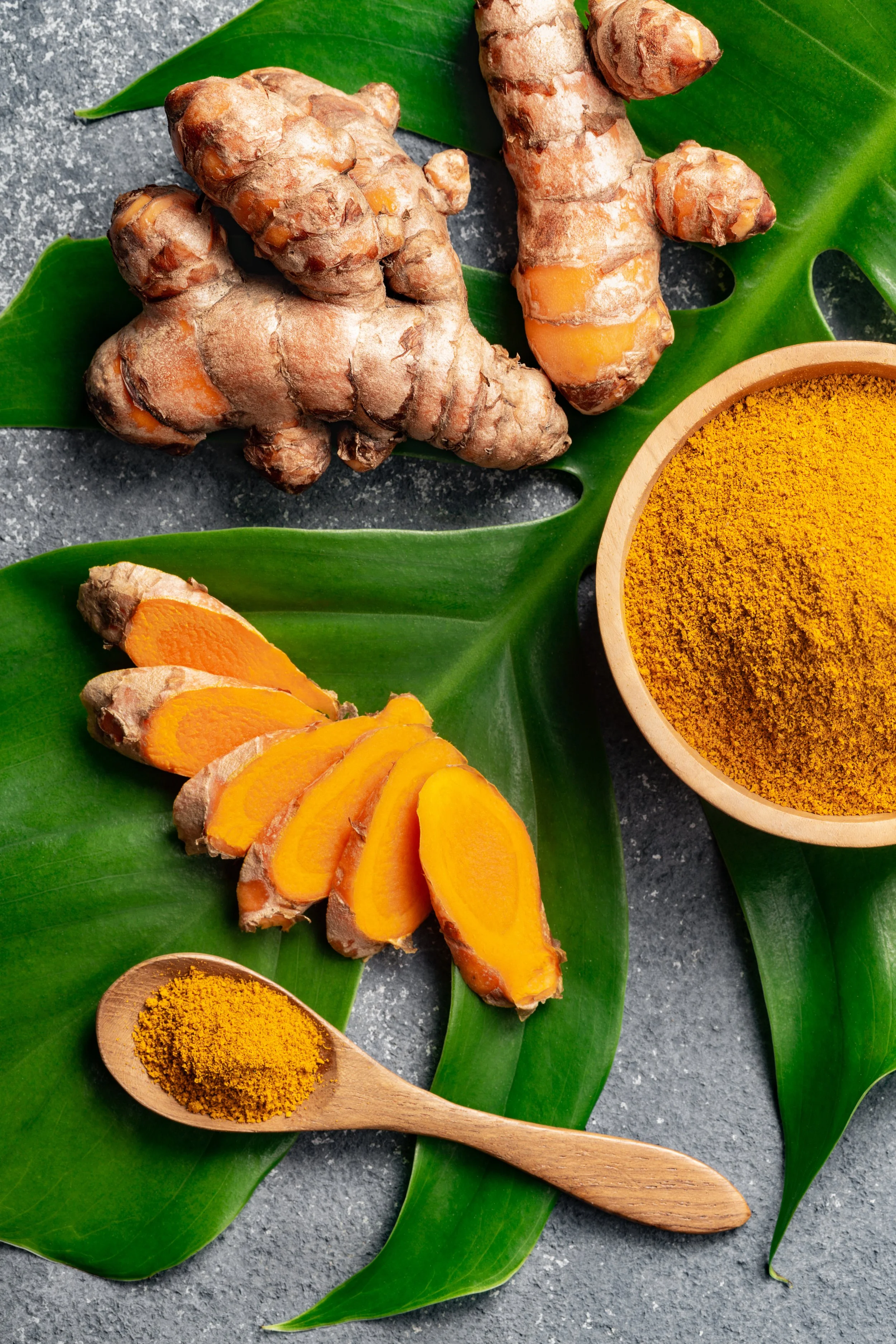
Turmeric is the dried rhizome (underground stem) of Curcuma longa, a plant in the ginger family. The compounds that give turmeric its deep orange-yellow color are called curcuminoids. The most-studied curcuminoid is curcumin, which makes up roughly half of total curcuminoids in most turmeric products; demethoxycurcumin and bisdemethoxycurcumin make up most of the remainder.
Ground turmeric spice typically contains about 3 percent curcuminoids by weight, meaning a half-teaspoon (about 1 gram) of ground turmeric provides approximately 35 milligrams of curcuminoids. Standardized turmeric extracts used in clinical research are typically concentrated to 95 percent curcuminoids, with doses ranging from 500 to 2,000 milligrams of curcuminoids per day, and as high as 8 grams per day in some cancer trials.
Curcumin is poorly absorbed on its own. Most clinical research uses one of several bioavailability-enhanced formulations, phytosomal complexes, micellar dispersion, gamma-cyclodextrin formulations, or co-formulation with piperine (a black pepper extract). Taking turmeric or curcumin with a meal that contains dietary fat also meaningfully improves absorption.
What Curcumin Does Mechanistically
In laboratory studies, curcumin suppresses NF-κB, a transcription factor that controls genes governing inflammation, cell survival, and cell proliferation. NF-κB is constitutively active in many cancer types and contributes to chemotherapy resistance, which has driven decades of preclinical interest in curcumin as a potential adjunct.
Curcumin also induces apoptosis in cancer cell lines across multiple cancer types and inhibits angiogenesis, the formation of new blood vessels tumors require to grow beyond a few millimeters. It modulates COX-2, the same inflammatory enzyme targeted by NSAIDs like celecoxib. These are laboratory findings, and the field’s challenge has been translating mechanism into clinical benefit.
The Human Evidence
Precancerous lesions and early-stage signals
In a Phase II trial conducted at the University of Michigan, smokers, a population at elevated colon cancer risk, took 4 grams of curcumin daily for 30 days. The number of aberrant crypt foci, an early precancerous change in the colon, decreased by approximately 40 percent. The 2-gram dose was not effective. This is a biomarker outcome, not a cancer-incidence outcome, but it was suggestive enough to motivate further trials.
Smoldering multiple myeloma and MGUS
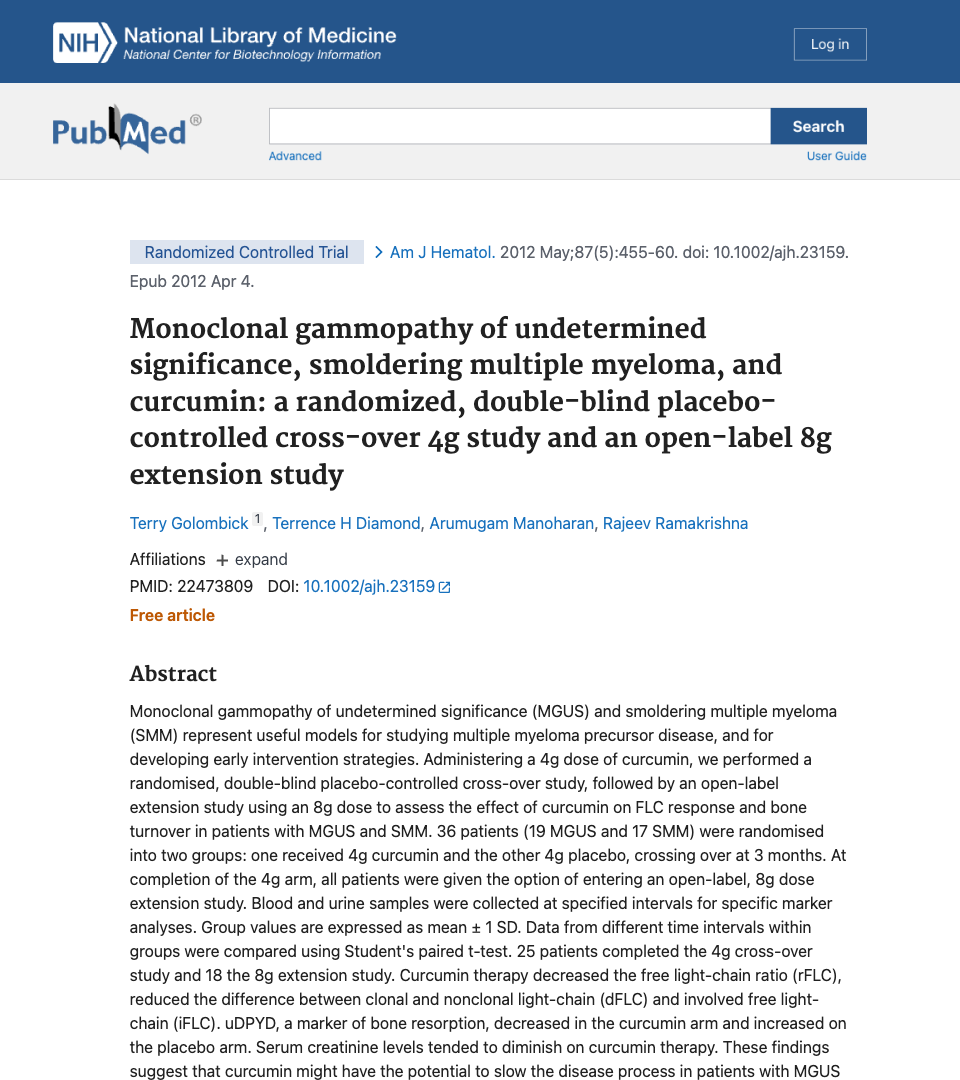
An Australian trial enrolled 18 patients with monoclonal gammopathy of undetermined significance (MGUS) or smoldering multiple myeloma — both conditions that often progress to active multiple myeloma. Patients took 8 grams of curcumin daily for three months. In patients with abnormal serum free light-chain ratios at baseline — a risk factor for progression — the ratio decreased by approximately 37 percent. Whether this translates to reduced progression to active myeloma compared to standard watch-and-wait remains an open research question, but the biomarker signal was striking enough that the research has continued. A related study in patients with active multiple myeloma (Vadhan-Raj 2007) reported reductions in inflammatory markers and NF-κB activity at 4–8 grams of curcumin daily, without clinical remission.
Where larger cancer trials have been mixed
Honesty about the field is important. A phase II trial of curcumin in 25 patients with advanced pancreatic cancer (Dhillon 2008) found biological response in only 2 of 21 evaluable patients. A 2021 randomized trial of curcumin (6 grams daily) added to docetaxel chemotherapy in metastatic castration-resistant prostate cancer found no improvement in progression-free survival, overall survival, PSA response, or quality of life. A 12-month curcumin trial in familial adenomatous polyposis showed no significant reduction in colon polyp number or size versus placebo. And a Crohn’s disease trial of curcumin added to azathioprine after bowel resection found significantly worse recurrence rates in the curcumin arm — a meaningful negative finding.
The honest summary: real mechanism, one interesting biomarker trial in a myeloma precursor, mixed-to-negative outcomes in trials of active cancer.
Culinary use
The everyday use of turmeric as a culinary spice is supported by population-level data on safety and by the modest but real curcuminoid content of cooked dishes. A half-teaspoon of ground turmeric in a meal with some fat is a sensible everyday intake with a low risk profile.
Cancer-Treatment Cautions
Bortezomib (Velcade) and multiple myeloma chemotherapy
Curcumin inhibits CYP3A4, the cytochrome P450 enzyme responsible for metabolizing bortezomib. Published case-report and preclinical work (Pochet 2022) document increased bortezomib toxicity — constipation, hematologic changes, peripheral neuropathy, rash — when patients combine high-dose turmeric extracts with bortezomib therapy. Memorial Sloan Kettering’s About Herbs database lists this interaction as a contraindication.
For patients in active treatment for multiple myeloma with bortezomib, the practical guidance is: do not take turmeric extracts, and discuss culinary amounts with your oncology team.
Tamoxifen and breast cancer endocrine therapy
A 2019 pharmacokinetic study (Hussaarts) in 16 women with breast cancer being treated with tamoxifen examined what happens when high-dose curcumin (1,200 mg three times daily) is added. Curcumin reduced tamoxifen exposure (AUC) by approximately 8 percent. More importantly, blood levels of endoxifen — the active metabolite responsible for tamoxifen’s anti-estrogen effect — dropped by approximately 13 percent. When piperine was added to the curcumin, the effect was larger.
The researchers estimated that this magnitude of reduction could push endoxifen below the threshold for clinical efficacy in 20 to 40 percent of patients, particularly those with certain CYP2D6 genetic variants who already have lower endoxifen formation. This is not a theoretical concern.
For patients on tamoxifen for hormone receptor-positive breast cancer, the guidance is: do not take turmeric extracts without first discussing with your oncology team. Culinary use of the spice has not been shown to produce the same magnitude of interaction, but extracts are a different exposure level.
High-dose extract hepatotoxicity
The NIH LiverTox database and the U.S. Drug-Induced Liver Injury Network (DILIN) have documented a recurring pattern of turmeric-associated liver injury. Affected patients are predominantly women, with an average age in the late 50s. Time to injury typically falls between 8 and 12 weeks of high-dose extract use, frequently with piperine. A genetic variant — HLA-B*35:01 — is enriched among affected patients.
This signal matters specifically for the cancer audience because turmeric extracts are commonly taken at very high doses by patients seeking integrative support, often without their oncology team’s knowledge. Cancer treatment itself can stress the liver, and the addition of a high-dose extract with known hepatotoxic potential is a meaningful safety consideration.
Product Quality
The turmeric supplement category has documented quality problems that consumers should understand.
Lead contamination
The FDA has issued recalls of turmeric products contaminated with lead between 2011 and 2017. Peer-reviewed environmental research (Forsyth 2019) documented that 11 to 26 percent of turmeric samples from Bangladesh exceeded that country’s lead limit due to lead chromate adulteration used to deepen the spice’s color. A 2021 case in the MMWR described turmeric purchased in the U.S. with lead concentrations of 2,000 to 3,000 micrograms per gram — high enough that a tablespoon could deliver thousands of micrograms of lead.
Potency variability
Independent supplement testing has repeatedly found turmeric products with curcuminoid content well below their label claims, sometimes by an order of magnitude. “Turmeric” products marketed online have also shown chemical signatures consistent with synthetic, fossil-fuel-derived curcumin rather than plant-derived material.
What to look for: independent third-party verification
Before purchasing a turmeric supplement, look for independent verification you can check yourself on the certifying body’s public directory:
USP Verified — the United States Pharmacopeia. Verifiable on the USP Verified Products directory.
NSF Certified — verifiable on the NSF product listings.
USDA Organic — for ground spice especially; verifiable on the USDA Organic Integrity Database. Independent testing has consistently found USDA Organic ground turmeric to have lower lead concentrations.
Or Manufacturer-published Certificates of Analysis from accredited third-party labs.
For products that satisfy these criteria as of this article’s publication: Kirkland Signature Turmeric 1000 mg (sold at Costco) carries the USP Verified mark. For ground spice, Simply Organic Turmeric and Great Value Organic Ground Turmeric (sold at Walmart) are both USDA Organic certified. Current certification status should always be verified on the relevant directory — credentials can lapse.
Data at a Glance
References
Carroll RE, Benya RV, Turgeon DK, et al. Phase IIa clinical trial of curcumin for the prevention of colorectal neoplasia. Cancer Prevention Research. 2011;4(3):354-364. https://pubmed.ncbi.nlm.nih.gov/21372035/
Golombick T, Diamond TH, Manoharan A, Ramakrishna R. Monoclonal gammopathy of undetermined significance, smoldering multiple myeloma, and curcumin: a randomized, double-blind placebo-controlled cross-over 4g study and an open-label 8g extension study. American Journal of Hematology. 2012;87(5):455-460. https://pubmed.ncbi.nlm.nih.gov/22473809/
Hussaarts KGAM, Hurkmans DP, Oomen-de Hoop E, et al. Impact of curcumin (with or without piperine) on the pharmacokinetics of tamoxifen. Cancers. 2019;11(3):403. https://pubmed.ncbi.nlm.nih.gov/31091818/
Pochet S, Lechon AS, Lescrainier C, et al. Curcumin and bortezomib interaction in multiple myeloma. Scientific Reports. 2022;12(1):17434. https://pubmed.ncbi.nlm.nih.gov/36284166/
Dhillon N, Aggarwal BB, Newman RA, et al. Phase II trial of curcumin in patients with advanced pancreatic cancer. Clinical Cancer Research. 2008;14(14):4491-4499. https://pubmed.ncbi.nlm.nih.gov/18452866/
Passildas-Jahanmohan J, Eymard JC, Pouget M, et al. Multicenter randomized phase II study comparing docetaxel plus curcumin versus docetaxel plus placebo combination in first-line treatment of metastatic castration-resistant prostate cancer. Cancer Medicine. 2021;10(7):2332-2340. https://pubmed.ncbi.nlm.nih.gov/33340270/
Forsyth JE, Nurunnahar S, Islam SS, et al. Turmeric means “yellow” in Bengali: lead chromate pigments added to turmeric threaten public health across Bangladesh. Environmental Research. 2019;179(Pt A):108722. https://pubmed.ncbi.nlm.nih.gov/31539801/
Memorial Sloan Kettering Cancer Center. About Herbs: Turmeric. https://www.mskcc.org/cancer-care/integrative-medicine/herbs/turmeric
National Cancer Institute. PDQ Complementary and Alternative Medicine summaries. https://www.cancer.gov/about-cancer/treatment/cam
National Institutes of Health, LiverTox: Clinical and Research Information on Drug-Induced Liver Injury. Turmeric monograph. https://www.ncbi.nlm.nih.gov/books/NBK548561/
U.S. Pharmacopeia. USP Verified Products directory. https://www.quality-supplements.org/verified-products/verified-products-listings
U.S. Department of Agriculture. Organic Integrity Database. https://organic.ams.usda.gov/integrity/
U.S. Food and Drug Administration. Recalls, market withdrawals, and safety alerts. https://www.fda.gov/safety/recalls-market-withdrawals-safety-alerts